
We meet again. On today’s topic, we’ll do a bit of worldbuilding. I mentioned a country in the previous dev blog, but today’s topic will explore a different one. While this city will not appear in the game itself, it is nevertheless important to the world considering its social and cultural significance.
Before that, however, I should give a brief overview of the world, at least part of it. Humanity has, for the longest time, inhabited a large continent. While other landmasses are known to exist, and some have been visited and briefly charted, the journeys and histories of humanity have never ventured beyond their “original” continent.
The continent goes by many names depending on the people that inhabit it. Some names include Terra Firma and Khersos. In the tongue of the people from a certain city we will be discussing today, they would use the term Hpeiros. During colloquial conversation, merely using “the continent” often suffice in conveying the meaning of the vast land humanity lives on.
It should be important to specify that the term “humanity” is all-encompassing. While one might be tempted to consider the Featureless as humanity, all the varying races, from the canine-eared humans of Tor to the dolphin-tailed people of Kallipolis and all the other diverse features of humans elsewhere, are all considered humanity. However, perhaps a common name is all they share, for the world still very much sees the differences among them more than they see the similarities. It is on this continent, filled with “humans” with all their storied histories, that the world develops from.
The city of Kallipolis rests upon the largest gulf of the continent, being one of the many cities that make up the Politeia Republic. The importance of Kallipolis cannot be understated, for it is not just one of the cradles of human civilization, but the origin of organized religion. It is of no surprise that religion would first arise from a place where humanity could vividly observe the vastness of the world Towering above them.
So, what is Kallipolis? One could describe it as a grand experiment. A successful dream by a council ages long past, yet nevertheless one could observe their ideals made manifest in the city’s governing principles. However, the people of Kallipolis are often looked upon with a gaze of confusion by others, even the other cities within the Republic. Their customs are deeply perplexing, yet none can deny it is a city that is successful, although some argue it is no place for humans to live.
The city of Kallipolis is divided into three distinct social classes, Artisans, Auxiliaries, and Guardians. Artisans are the labor class of the city, and they are farmers, laborers, and any other profession that largely has to do with the daily lives of the common people. The Auxiliaries could be generally understood as civil servants, being in various professions that serve the state, such as bureaucrats and soldiers (most of them are soldiers, however). The Guardians are the ruling class, yet they are the most unique among them.
The society has no limit to social mobility when it comes to artisans and auxiliaries, with each citizen free to choose what they wish to be. Guardians are a special case and are selected from the Auxiliaries (based on merit). They will then be given extensive training before being accepted into the fold.
There is another way of entering the Guardian class, however. That has to do with the quirkiness of Kallipolian society. The Guardians are strictly forbidden from starting a family, be it forming a connection with another or having children of their own. It is their belief that familial bonds will only distract them from their duties to the state, and as rulers, they have given their entire lives to rule.
For many other places, and our real world too, humans are quite familiar with the notion of individualism, even from young. We have our dreams, preferences, and characteristics that make us who we are. However, within Kallipolis, the very concept of the individual is obliterated, subsumed under a grand dream of the “beautiful city”. The children of the Guardians are the greatest example of such.
While I mentioned Guardians cannot have children of their own, that does not mean reproduction does not exist for the Guardians. Instead of being a product of great joy and love, the very concept of children has been recognized as one of systematic production. There is no familial connection when it comes to childbearing and raising, it is merely an activity done in service to the state, to produce the next generation of leaders.
The children of Guardians grow up in a community of Guardians, with them not knowing their parents, and the parents not knowing their children. They are raised collectively as a community, and those born around the same time refer to each other as siblings. The Guardians, therefore, are collectively their parents, with no individual able to lay claim to the title of parent of any particular child.
This upbringing is also particularly harsh, as they are raised to be better Guardians from young. They are expected to be proficient in all fields of academics, the arts, and military doctrine. Even as children, they would follow their “parents” into war, and it is there they are expected to become not just masters of theory, but also formidable warriors that can take command of the massive Auxiliary force they would soon take charge of in their adult years.
It is within this practice one can see the underlying darkness beneath this alleged utopian dream. Children are produced with an uncaring nature, conceived with the selection of desirable traits in mind. In other words, Kallipolis practices eugenics among its Guardian class. It is to ensure children are not just raised with merit but are born with talent. The Guardian class also selects parents to ensure the most desirable genetic traits, and within “festivals” they match these candidates together to conceive children.
There are times, of course, children are born with deformities, or are born to parents who are not allowed to reproduce due to the aforementioned “matchmaking”. It is those times the children are left out in the woods to die, but there are times when members of the Artisan and Auxiliary class, who are allowed to have families of their own, would occasionally adopt these children should they stumble on them in the wilds.
Those who survive the process are given equal education of the highest quality, but rather than a belief in equality, it originates from a position of cultivating a population that is shaped in a common mold. The strict control of human reproduction, the elimination of the typical family, and a uniform system all come together to form a cohesive society that binds them together on a societal level rather than divide them along family lines.

People from beyond the walls of Kallipolis often view such practices as heartless or odd, but the people within have come to accept this as a way of life. In fact, people who are not within the Guardian class enjoy great freedoms not seen in many parts of the continent, and the city itself has stood for as long as humanity began to record history.
The citizens enjoy far more rights than other places on the continent, provided they conform to the system. The brutal system of the Guardians carry the society on their backs, but the citizens are expected to serve the state in some capacity as part of the social contract. The Auxiliaries provide much-needed manpower and are the arms and legs of the Guardians, while the Artisans represent the “human” aspect of an otherwise utilitarian state.
Despite all that has been said about Kallipolis, they are still a society that places great emphasis on the human soul, allowing creativity and the arts to blossom. It is undeniable it is a society that is deeply fixated on objectified “good”, but it is also a society that is deeply concerned with philosophical thoughts of the human experience.
Observant readers would have likely made another interesting connection. One of the party members who is said to hail from Kallipolis, is in fact once a member of the Guardian class. She was born and raised to be a Guardian, yet by her own will, has chosen a different path in life. How has such a life affected her? Why did she walk away from such a society? More will be explored in her dedicated blog post.
Inspiration and Further Remarks
It’s no secret that Kallipolis is heavily inspired by the works of Plato, specifically the Republic.1 Kallipolis is Greek for beautiful city, from kallos (beauty) and polis (city). It can also mean “good city” in some contexts.
One could identify Kallipolis as a utopia, although one would also be quick to identify the notably dystopian aspects of it. Its eradication of the individual, the eugenics, and the strict enforcement of class division. That is very much intentional, as I wanted to present a utopia that provides thought-provoking questions, rather than a perfect place.
Utopia as a term was first conceived by Thomas More in the book of the same name, featuring a character named Raphael Hythloday discussing a supposedly utopian society. However, those familiar with Greek, or perhaps the study of utopia, will realize that utopia means “no-place”, and more interestingly, Hythloday means “speaker of nonsense”. The entire reading of Utopia is quite confusing for many different reasons and is subject to different interpretations, but just those two notable points provide a starting point for thinking about this topic, and Kallipolis as a whole.
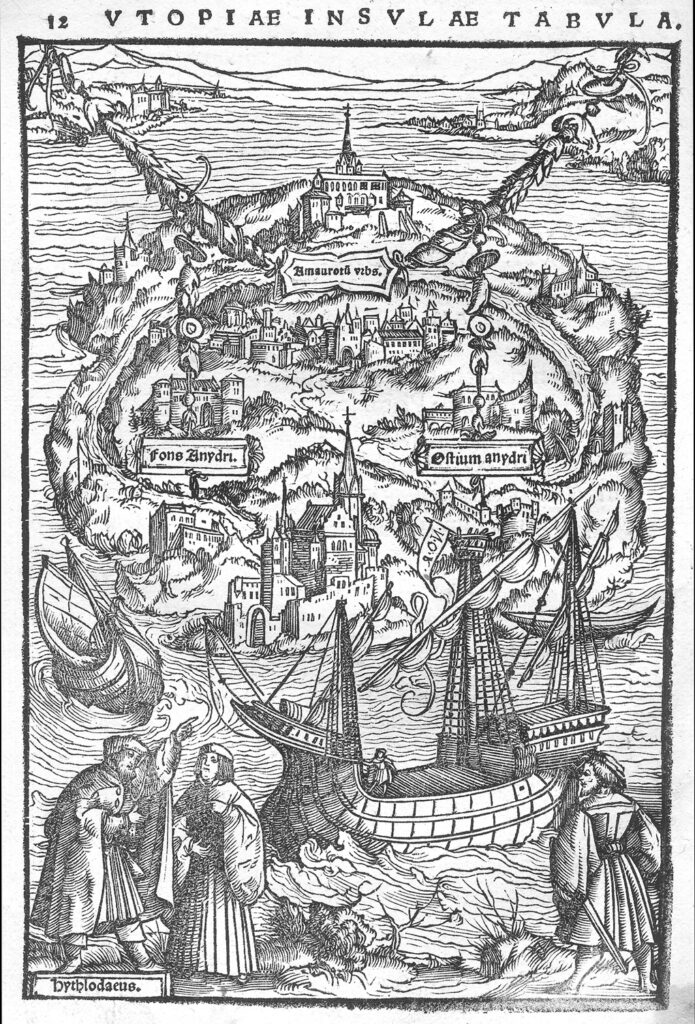
Kallipolis achieves its prosperity through different means than those we deem to be good. Its ideals stand against ours, yet it remains standing as one of the oldest cities known to humanity in that world. Is such a city attainable? Or is it merely an interesting thought experiment? Perhaps it’s meant to highlight aspects of our society precisely because it’s so radically different?
What are your thoughts? Is utopia as an ideal place (an eutopia, meaning “good place”) better? Or does an imperfect one speak more of a society? Is Kallipolis a utopia to you, or a dystopia? I personally find utopias to be quite an interesting topic, and I hope you have as well.
While Kallipolis isn’t a central focus of the game, one of the playable characters does originate from such a city. Along the journey, players might encounter others who have walked away from the fabled city of ideals.
That’s it for this time’s blog. What topic would everyone like to be explored next? I have read the comments, and I could do any of the suggestions. Perhaps the premise of the game? Or an anthropology blog about a specific group of people, such as the featureless? Or maybe a certain word in this blog that has no business being bolded…?
Until next time.
-Rita.
- The Republic by Plato. ↩︎
- Utopia by Thomas More. Map retrieved from Princeton University Library. ↩︎