
Welcome back. Riifushi has a habit of demanding a companion blog out of the blue, perhaps I should start organizing a labor union next time. Anyway, today will be a companion blog to her video, which I presume is where most of you came from. For those new here, a companion blog will not cover the same information Riifushi did in her video; rather, it will give a different but hopefully interesting perspective.
While it is ultimately a companion blog about Margarita Illiolousti, I would like to brush in broad strokes first, as her character is designed with several notable factors that would hopefully make sense after this dev blog. Additionally, I would recommend giving Dev Blog #2 (Kallipolis) a read beforehand if you have yet to, as it provides vital context to what will be discussed here. Otherwise, let’s begin.
Design Philosophies: Organizations
In any fictional work, it is common to encounter fictional organizations or institutions, as it is a simple way of creating a world that feels alive. However, when we create these institutions, we should give thought to how these entities are formed in the world. While this sounds self-evident, I am not just referring to the basics of creating organizational structure. Put differently, if the purpose of an institution is to make your world feel alive, then simply creating reasons for the organization to exist, what the organization does, or other factors one might consider as the foundations of creating institutions, is often not enough. We often view fictional organizations as monolithic, the worldbuilders would leave the organization as functioning towards some sort of end goal without digging beneath the surface, but often forget institutions are, ultimately, human creations operated and participated in by humans.
I use the term “organization” or “institution” to distinguish it from the nature of countries and politics, which often feature changes we can grasp and see in fictional worlds. Wars, notable events, et cetera are all examples we often see in bringing depth to countries on a macro level, but what about on the micro level? Fundamentally, albeit reductively, human society is constructed on many different institutions, all interacting with each other to create the world humans live in. To create an interesting world is not just thinking about the bigger picture and giving it history, but considering what makes up that larger image. You can’t build an apartment block by throwing an entire building down, you have to consider plumbing, electricity, and access, among thousands of smaller things. What I’m trying to say is that even if you talk about an organization or institution changing, it often feels empty if the author fails to peel back the layers.
While there are plenty of other ways to make organizations more interesting, today, we’ll be discussing this specific notion of institutional change, using an example that has to do with the character featured in Riifushi’s recent video. Organizations, much like a character, are capable of growth too. Especially for organizations that have existed for a long time, how they change over time adds much-needed depth and flavor to a fictional setting. It could be difficult to perceive organizational change as opposed to individual change, as it occurs over a timescale most of us are unfamiliar with. I am certain the concept of character growth is not foreign to most of us, then how do we approach the idea of organization growth (or rather, change)?
Institutional capture is a concept that typically refers to a change in authority when it is “captured” to have the institution serve a different set of purposes other than its originally intended purpose. Corruption, so to speak. While it typically is used with a negative connotation, we can perhaps use this idea and imagine it in the realm of institutional change, regardless if it’s for the worse or better. At the risk of generalization, institutions, for the most part, operate as some level of an unconscious entity driven by forces bigger than any one individual. The manner in which an organization is set up and operated plays a role in how it develops over time, leading to subtle change over a generation, but considerable change when it’s spread across multiple generations. Theory is perhaps abstract, so let’s look at an in-world example I have prepared today.
Margarita Illiolousti is part of the Church, a religious organization first founded upon the basis of cultural and superstitious beliefs surrounding the pillar of Kallipolis. It can therefore be understood as the first institutionalization of religion in this world. What was their purpose? On the surface, it seems self-evident in the name, of spreading and maintaining the faith. However, crucial to us is knowledge of a certain branch of the Church, known as the Ecclesiarchs, who are charged with the duty of recovering relics and artifacts scattered across the world. These items, all ranging from harmless trinkets to incredibly dangerous yet powerful national treasures, are thought to be in some way related to the pillars of the world, and thus were objects of immense value the church sought to collect, be it for a religious or practical reason.
However, over time, this section of the church began to become more influential. To search and secure these relics required more resources. With more resources, this part of the church began to attract more talent and manpower, which inevitably resulted in a bigger say in the workings of the Church. This faction of relic seekers is thus born not from any single event or individual, but rather the consequences of the Church simply existing and pursuing its logical purpose (searching for relics tied to their faith). One could then observe an “institutional capture” from within. As the church empowered this department for its purposes, this department began to “corrupt” the Church. However, the department is not seizing control nor diverging from the core tenets of the Church, not at all. In fact, they are still deeply loyal to their original purpose, searching and safeguarding relics, even to this day. Yet they have captured the Church with that purpose, not a result of malicious scheming, but a series of actions and consequences that no single individual is to be blamed. Of course, I am not saying institutional capture cannot exist in a malicious form, but such is the case that occurred in this world.
The Church, over time, became increasingly focused on relics, as if the entire Church had become what was intended to be a sub-department. The institution’s original purpose of spreading and congregating faith became a lesser priority. This manifests in the current day as a seemingly pragmatic religious organization. While the masses may hold genuine faith, the organization itself is less interested in scripture. The outcome justifies the dogma, instead of the other way around. Religion becomes a means to wield influence to aid in the unending search for relics, with the spreading of faith turning into a means to an end. As a result, the Church is more than happy to absorb fringe religious beliefs and local spiritual practices into the Church, making the organization entirely unrecognizable, but far more palatable across different cultures. What was merely a regional Church in Kallipolis soon became a global power, and one can point towards its malleable faith and pragmatic pursuits as a contributing factor.
This discussion on the background of the Church is to illustrate my point surrounding the concept of institutional change. When I speak of change, I am not referring to an event causing A to happen which causes B. Nor is it about an individual leaving an immense mark on history. These approaches can be done well, undoubtedly, but I am here to offer a different perspective. What of change that is contextualized by the dynamics of institutions? An organization shaped by forces that cannot be pinned down by any single reason in a given moment. Again, this is but one way of making organizations in your worldbuilding interesting and dynamic, rather than monolithic and unchanging organizations.
Margarita Illiolousti
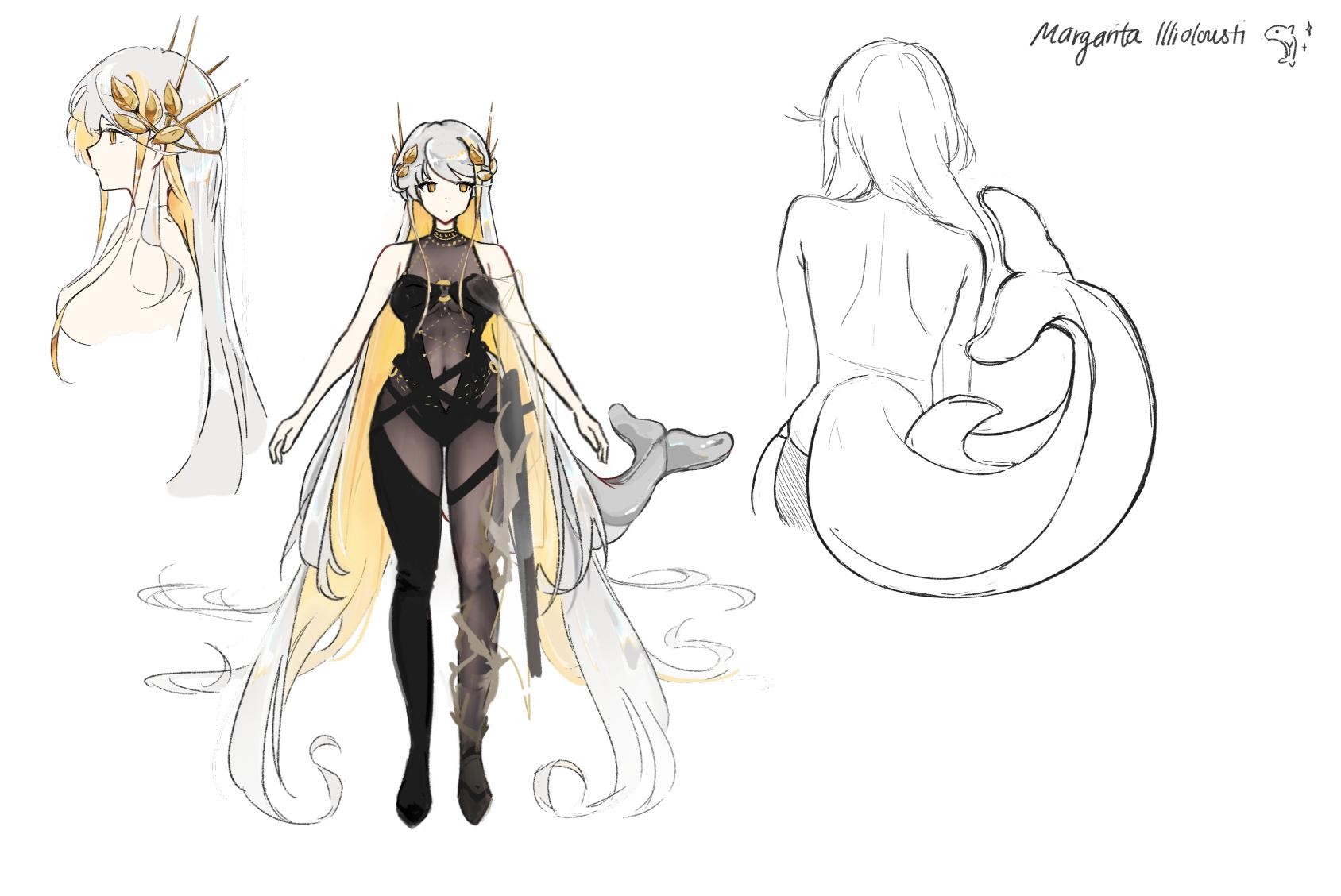
Then let’s finish with some closing remarks about Margarita. While I did speak of organizations on an abstract level, Margarita offers a contrasting perspective at an individual level. What we’ve discussed is beyond any single individual, but that is not to say the individual experience isn’t important, quite the opposite in fact. The small, personal stories are what bring overly abstract discussions of institutions and organizations flavor. It is how individuals live their lives and grow in the backdrop of such immense forces that brings perspective to what the changes of organizations really mean.
Margarita’s character is precisely meant to draw attention to this contrast, as her life is deeply intertwined with “institutions”. As I mentioned in the dev blog discussing Kallipolis, Margarita’s origins are viewed by many as a “utopia”, yet are managed by strict hierarchies. An institution made to maintain utopia, in today’s context. Yet Margarita is someone who could not live in such a utopia, she is someone who disagrees with the vision based on a very human ideal that the Kallipolis institutions have largely neglected: family. She cannot accept the eradication of individuality to serve an institution that sees beyond any one person. Even when she walked away from Kallipolis, she was confronted with a different problem. The Church, an organization that is built upon human ideals, has utterly abandoned them in the process I have described above. In essence, Margarita is interesting precisely because she is someone who is trapped within these organizations. It enables us to view these deeply complex organizations and institutions the author has created, but brought down to a street-level view.
The party of four is designed with these philosophies in mind, with each of them representing an interesting aspect of the world they inhabit, but at the same time, their personal struggles stand out among the noise of the masses. Margarita is the character that is most suited to be used as an example, hence the previous discussion. She carries with her the shadow of two suffocating institutions, but her journey is a deeply personal one. Unlike Natalija who can be characterized by “obsession”, Margarita holds a personal crisis of faith, yet carries great potential within herself. When describing Margarita to Riifushi, I used this phrase which I feel sums her up, “Margarita is the protagonist of a story, but this is not her story”. In the party of four, everyone has their own story and personal struggles. Yet among them, Margarita stands as one whose tales rank as the most fantastical. Even so, this spotlight is not hers alone to take. She surely has bigger concerns to attend to, more fearsome evils to vanquish…yet she will walk this road with our party not as a Guardian of Kallipolis nor an Ecclesiarch of the Church, but as Margarita Illiolousti, an individual suffocating under the weight of her convictions.
Thank you for reading up until this point. We may have one or two dev blogs before the next companion blog, so please do let me know if there are certain aspects of the game you would like to hear for the next dev blog. Don’t be afraid to comment or ask questions too. Until next time.
- Sketch by Riifushi. ↩︎