
Originally, I intended to do a blog about the premise. I was halfway through that one when I realized Riifushi was quite close to finishing her video, so I had to quickly whip this one up from the depths of my notes as a companion blog. Anyway, a welcome to the new folks, and let’s continue.
This dev blog is written with it being a “companion blog” in mind. In other words, it will give some additional context and information that could not be included in Riifushi’s video, and it’s best enjoyed after watching her video. I assume most of you will come here from her video anyway, so it should be fine. That being said, the content will largely not overlap with what has been said in her video, so there won’t be repetition. Expect this to be the format of all companion blogs in the future, unless stated otherwise.
As Riifushi explained, the two siblings were born into a life of war. Their first memories are of each other and their brother, who has long departed the world. For as long as they can remember, they have fought together on the battlefield for their entire lives. Some would consider this to be a tragic life, and certainly, it’s terrible. However, I think it represents one aspect of my design philosophy, and that will be what I will discuss first.
Characterization and “Othering”
When designing characters, it’s quite easy to view the character’s world from your own point of view and allow that to taint their character. It is commonly known as “othering”, and while that term has been used by many different fields in wildly different contexts, for today’s purpose it means to treat someone else’s experience as existing distinctly outside of you.
Perhaps we, as people of the modern age, recognize the horrors of a denied childhood and a life solely on the battlefield. Therefore, when creating a character that possesses experiences different from our own, it creates this “othering” effect. It would then be easy(for us) to imagine Jevo to be someone who has suffered greatly, one who might be shaped by a horror that we assume it is. That, to simplify, is “othering”.
We place our expectations of the world onto Jevo, and thus have Jevo behave and react to it as how we would think would be right. Certainly, it is an abstract idea to grasp, and I myself have grappled with this over my years of writing fictional characters and worlds. However, in my opinion, this approach of projecting our ideas of the world onto the characters we create reduces the “humanity” of these characters.
Characters become complex and well-written when they behave as humans do, all wildly different from one another. We who have the sensibilities of the modern world are far different from Jevo. Jevo, perhaps, has lived all his life on the battlefield and therefore thinks nothing of it. To us, it is a horror to subject childhood to war, but to him, it was simply how his life turned out.
What I am trying to say is the more we can see things “as it is”, the less we see characters as an “other”, the better we can craft our characters. If every character shares similar values, then it quickly becomes repetitive, does it not?
We could put that into an exercise, recreated from when I was contemplating how to write Jevo. Let us imagine how Jevo would think and perceive the world. He was bioengineered, experimented on, and made to fight wars. At the end of it, he would be left to die at a young age.
Our first instinct is to feel horror, disgust, and other unpleasant thoughts on behalf of him. However, to Jevo, that is his entire life. The fact that he will die sooner than others, is merely a fact of life for orphans of war like him. If that’s the case, then the first thought that dominates his mind would not be disgust at such a ridiculous system. Perhaps, then, it would be focused on the people he bonded with in his short life. Like his “sister”, perhaps. Both share a similar life and circumstances, and it is through that they bond.
Yet, such a one-dimensional manner of designing characters is still not enough.
Humans are deeply complex creatures, and we are able to bring a bit of “spice” to their fictional characterization. Despite viewing their lives as a fact of reality, that does not mean Jevo could be happy with it. He yearns to live, someone who knows nothing of it. It is through that these two siblings found themselves striving for a new life.
Make no mistake, I am not saying it would disqualify Jevo from seeing things from an opposite perspective. Things are rarely painted in absolutes, it’s the nuance in between that makes things difficult. I’m suggesting that characters could react differently from how we expect them to, and it is that nature that makes characters compelling. They are people too, and their perspective of life is shaped by their personal circumstances.
Design as Game Systems
Another topic I would like to expand on is the notion of incorporating design choices into game mechanics themselves. In Riifushi’s video, she briefly touched on Jevo’s bioengineered body having a gameplay function as well. That is essentially what I am referring to. It is the idea that the game systems could manifest themselves as a sort of flavorful rendition of the “lore”, so to speak.
In Natalija’s case, her gun can be customized to various effects, representing her nature of constantly toying with new prototypes and ideas. In the case of Jevo, it is the concept of having access to powerful abilities, but with downsides. The further you push Jevo’s body, the more powerful Jevo becomes in combat. However, more penalties get stacked upon each other the further you burden his body. It creates a sense that you are quite literally breaking Jevo’s body apart as you push for higher damage.
I personally place great value in such “personalized” systems. I feel it tells a story about these characters without it being a cutscene or dialogue. How characters perform in combat possibly makes the player feel a certain way about them. Games should not be viewed separately as “there’s a story section, now here’s a gameplay section”. If one can integrate these two parts together, then it truly maximizes the potential a game has for storytelling.
Of course, this burdens the technical side of creating a game. Designers can go on and on about what is cool and everything, but at the end of the day it would be someone else who takes the fall. In this case, it would be Riifushi having to code ridiculous systems or make an asset that is frankly an insane demand. There is always a careful balancing act, and oftentimes you see uniform systems for this precise reason: it is far easier to program, and the increase in flavorful mechanics was deemed not worth the price of having your programmers go through a mental breakdown.
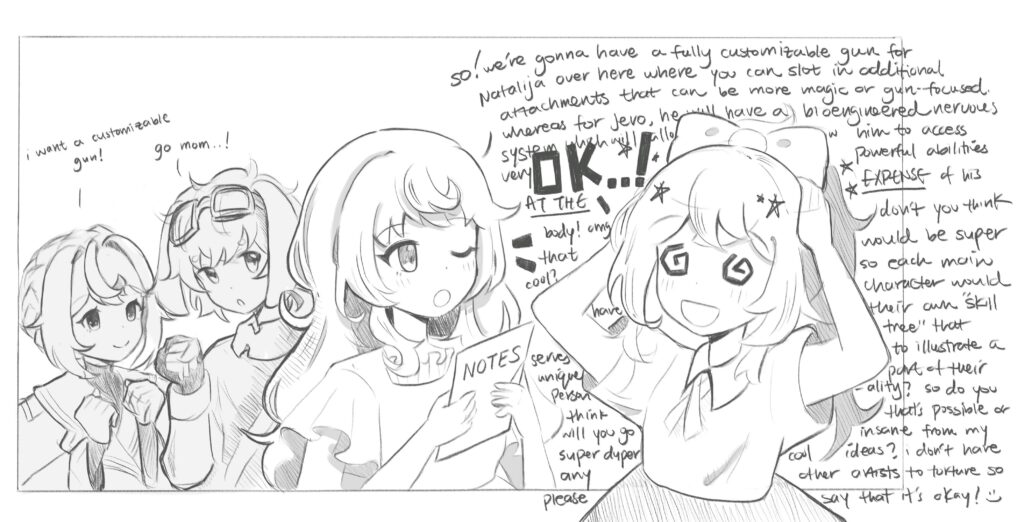
However, that is something I really want to try. To have a flavorful combat system, at least when it comes to the playable party’s individual abilities, that tells its own story. Natalija, who overwhelms the battlefield with her madness and her unique view of the world. Jevo, who deals high burst damage, but at a cost to himself.
It is no doubt ambitious, and those I have spoken to about the game have regularly expressed that. Perhaps it’s naive and idealistic, but I would nonetheless hope to make a game that represents my thoughts of great design. I really want to capture the awe and wonder I myself have experienced when I played games that I have found to be great. Perhaps, when the day comes, you, my dear reader, will be able to share in that wonder in this work I wish to create.